
The volunteers who did the recent work on the hedge improvements are sincerely grateful to the several gardeners, who spoke to them to offer to help with the planting of replacement hedging where the problematic, fast-growing subjects have now been removed. That assistance would be of great value and benefit, and so these kind ad hoc volunteers are invited to contact PPAA Committee by email (using the message page if they don’t have the address.) If everyone’s in agreement, then an email group etc. can easily be set up to co-ordinate the work.
Now that the somewhat onerous initial stage is over, the extent and type of work needed is clearer. It’s pleasing to see that there are quite a number of good mixed hedging subjects such as holly, hawthorn, and berberis. (There are in fact more of these than at first sight, because some had to be cut back quite rigorously to access e.g. sycamores for suppression, but they should readily sprout again.) This means that good replacement plantings can be done more simply than was at first thought to be likely, and the volunteers think that – at least as a holding position – infilling the gaps with pyracantha – firethorn – would tick all needed boxes for the time being, and other items – such as honeysuckle – can be planted among them at any time after.
Pyracantha* really is a very good thing to plant for this purpose. It’s attractive, dense, extremely thorny, and has strikingly colourful berries. Moreover, it’s evergreen, so continues to grow all year round. It’s also available from everyday suppliers in convenient form for planting, as here in the case of B&Q.
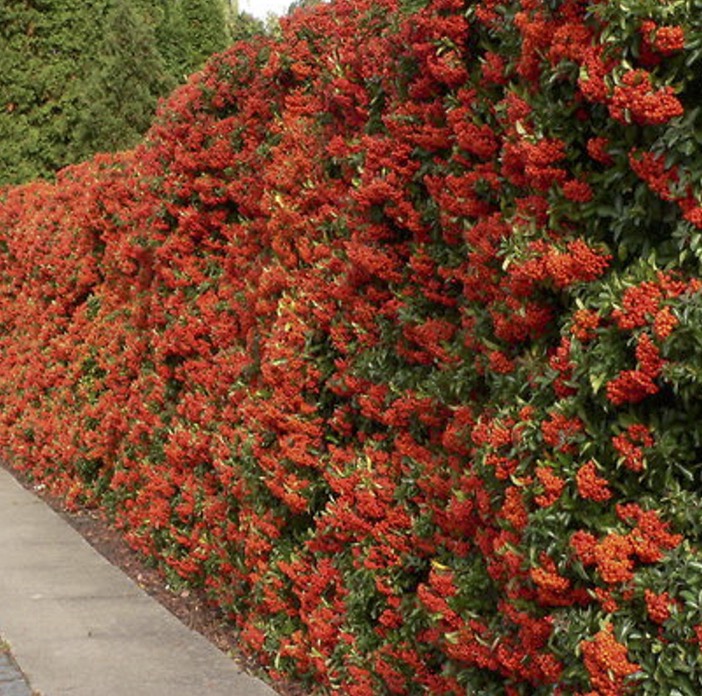
It’s not just for the enhanced benefits to site security, appearance, and wildlife support that this work is being done. PPAA are charged with the maintenance of most aspects of the site under a Local Management Agreement deed with the Council. It’s implicit in that duty then, that PPAA must preserve or improve the maintainability of the site. That means, that where possible, the burden of the work involved in so doing be reduced, so that there’s less for volunteers to do, or less expense involved in paying contractors to do it. In this case, where a fast-growing, tall hedge – which needs cutting three or even four times a year – can be transformed into one of moderate height, which only needs cutting once, then it behoves PPAA Committee to do this. Furthermore, such a transformation also greatly reduces the amount of biomass arising from such work and which requires disposal. This in turn frees up funds to support the central task of the Association, which is to ready plots for occupation by new tenants, that is, Cardiff Council Tax payers from the Waiting List.
*The Local Management Agreement – like our tenancies – doesn’t permit the planting, by anyone, of broadleaf, conifer, or willow trees anywhere on the site, and there’s no dispensation for doing that as hedging either, so pyracantha, which is generally considered to be a shrub, avoids any difficulty in this regard.
PPA Website Team

Many thanks to those who’ve emailed to say that they’ll help.
We’ll probably invest in paid labour to dig all the planting holes, which will mean putting in the shrubs, back-filling, and perhaps mulching. This ought to make the job far less demanding of both time and energy.
There will perhaps be two hundred to two hundred and fifty such plantings.
PPA volunteers.
LikeLike