Introduction
It’s probably fair to say that very few people have ever met a gardener, who wasn’t sensitive to nature and to its beauty. Trees are a central feature of that beauty, which is why we find so many in parks and in gardens. They’re also of great importance in supporting many species of wildlife, and so, for good reason, they’re often the subject of protections, such as Tree Preservation Orders, and Conservation Areas.
The necessary curating of parks, gardens, and so on, means that trees aren’t always inviolate however, and the maintenance of the proper purpose of land generally means that many trees will have to be pruned, transplanted, or sometimes felled.
The PPA site is fortunate in having many attractive trees around, and in places, on it. There are the hawthorns in the row beside the northeast boundary, and the sycamores and maples in Llandaff Fields adjoining the southwest boundary. We have the magnificent and interesting oaks on the embankment besides Road Three on the site, along with the miscellany of specimens besides the Western Avenue boundary, and finally there’s the intended row of graceful silver birches, planted, we understand, as a planning condition for the development of WJEC, on its land adjoining PPA.
The situation on PPA
Over the years these trees have grown, and have, inevitably, caused some problems for the PPA site and for certain plots on it. The hawthorns by the spine road were hanging low enough over the hedge to starve it of light, and so it became sparse and insecure. (There was clear evidence, that intruders had entered through it on the night of the appalling arson attack on the Riverside Community Gardens shelter.) The trees by Road Three were also hanging very low over some plots, making areas of them quite useless for growing, and there was scope for improvement in that regard for the plots beside the historic wall too. So, after very careful consideration, a program of works was decided upon by PPAA Committee, and those deliberations happened in the light of what Jon Maidment – Head Of Parks – had said at a gathering of Site Representatives, delegates, and other Council officials. Our understanding of that was, that where Associations encountered a need to deal with problems stemming from trees, then notwithstanding the letter of Tenancy Agreements or LMAs, the Council would tend to take an understanding view of decisions and actions taken by them to help.
Legal and contractual considerations
No work on trees subject to Tree Preservation Orders or which are in a Conservation Area can be undertaken without planning consent. At the time of the works though, none of the trees considered for work were subject to either of these.
When it comes to work on trees not growing on PPA, but with overhanging branches, e.g. those in Llandaff Fields, then the common law of Abatement of Private Nuisance allows for those branches to be lopped by the occupier of the affected land, as this article by RHS explains. Neither notice to, nor consent from the other landowner are required.
Whereas both the Tenancy Agreement and the LMA say that no conifer, broadleaf or willow trees must be planted or maintained about the site, provision six of the Tenancy Agreement says (perhaps apparently contradictorily) “6. The Tenant shall not without the like consent, prune, or remove or interfere with any timber or other trees…” However, our view is, that a proper interpretation of the meaning of “trees” in that context could only sensibly mean trees growing on PPA site, otherwise the tenant would be prevented from working on any trees – including his own at home. In other words, it doesn’t prevent work on trees such as the hawthorns by the Spine Road. That interpretation has been put to the Council as intended for consideration by their Legal Services, but so far they’ve remained silent on the matter. (This might be a subject, on which a legal professional could in future contact the Council.) So it’s taken to mean that trees large enough to be “timber”, that is, of landscape significance, and actually growing on PPA site shouldn’t be pruned without Council consent, but then again they’ve also stated that disallowed trees growing on plots can be removed whatever...)
Works to hawthorns beside the spine road hedge
After the arson attack on RCG, the Council’s Allotments Officer, Celia Hart, visited PPA to meet Sue, Site Rep, and to discuss what might be done to improve security. To increase lighting to the Spine Road hedge, Celia proposed the complete removal of every other hawthorn tree.
Sue considered this to be unnecessarily drastic, and perhaps not the most effective solution. So, at Committee, it was decided that to retain all the trees, but to crown lift them would be far better, and no objections were raised to this proposal. A pole pruner was bought, and four volunteers did the work, which seems to have been very effective indeed, with both the hedge and adjoining bramble thicket now growing profusely, making the whole length of that boundary section secure. The volume of nesting medium for a number of bird species has also been greatly increased. (These trees formed the historic boundary hedge for PPA, and custom-and-practice has always been that PPAA maintained both them, and the land between them and the present-day fence.)
Works done by contractors
Some of the works, e.g. at a height, or involving the removal of large trees where plot holders had requested assistance, required the expensive services of professional arborists. The works done included the coppicing of some overgrown hedging by Western Avenue, and the very modest pruning of the oaks and so on by Road Three, which nonetheless greatly improved matters for several plots there. It perhaps needs to be made clear however, that contrary to some inaccurate reports apparently circulating, no sitting tenant has had any tree removed without their agreement.
Overhanging branches from Llandaff Fields
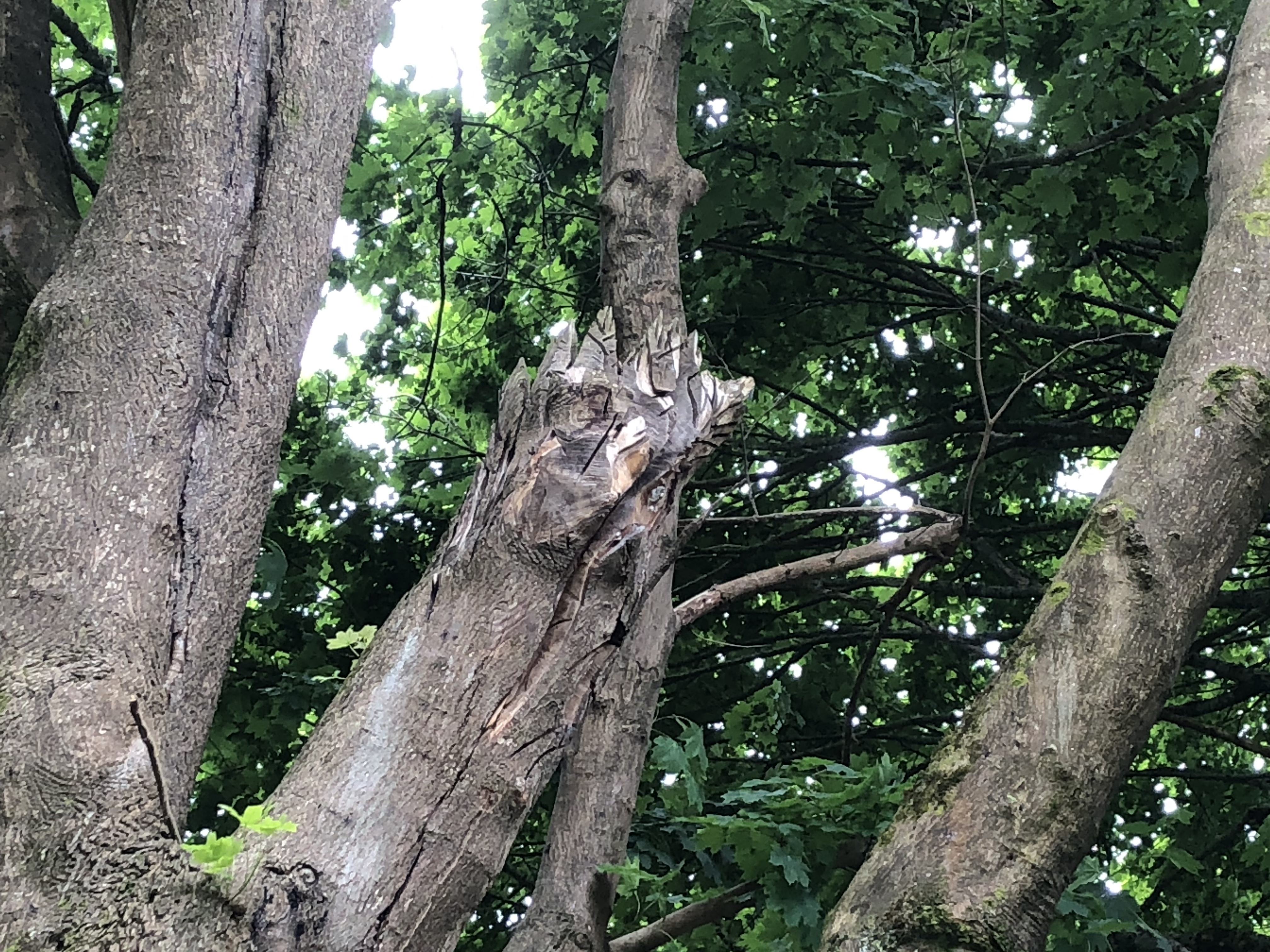
These works were done by volunteers on the claimed legal basis explained earlier. They involved the removal of relatively few low hanging branches, but despite the limited scope of the works they made a very worthwhile improvement to the growing conditions of eleven plots. (They were overseen by a volunteer with a working life background that included safety considerations in the project management of public events.)
(It’s worth noting, that although the method used didn’t usually result in clean sawn ends, the Council’s arborists themselves deliberately simulate rough breakage of boughs in parks to avoid the stark appearance of amputated stumps.)

Allotments Officer did express some concerns however, about certain aspects of these works, mainly relating to safety, and her advice is being followed.
The trees along the WJEC boundary
At one time, there was a row of large sycamores along the End Road, but these were felled, perhaps to facilitate development of the WJEC site. The stumps were deactivated, and the remains of some of these are now covered in ivy. (One of them was kindly removed completely by a then volunteer from RCG, Frank Berry, which made access and turning for vehicles far easier.)
There are now some nearly mature, graceful silver birches along this boundary. As mentioned, our understanding is that their planting was a Planning Condition of the WJEC development, and that they were intended to form a continuous row for its full length.
However, perhaps for practical reasons, WJEC have put up their security fence on the inside of that row of trees, which seems to have led some to believe that the trees are on PPA site, but our understanding again is that this isn’t the case. Nonetheless, for their own purposes, we gather that the Riverside Community Gardens volunteers – and perhaps others – have either removed or significantly pruned some of these trees, and so the row is now only partial.


Dead or diseased trees
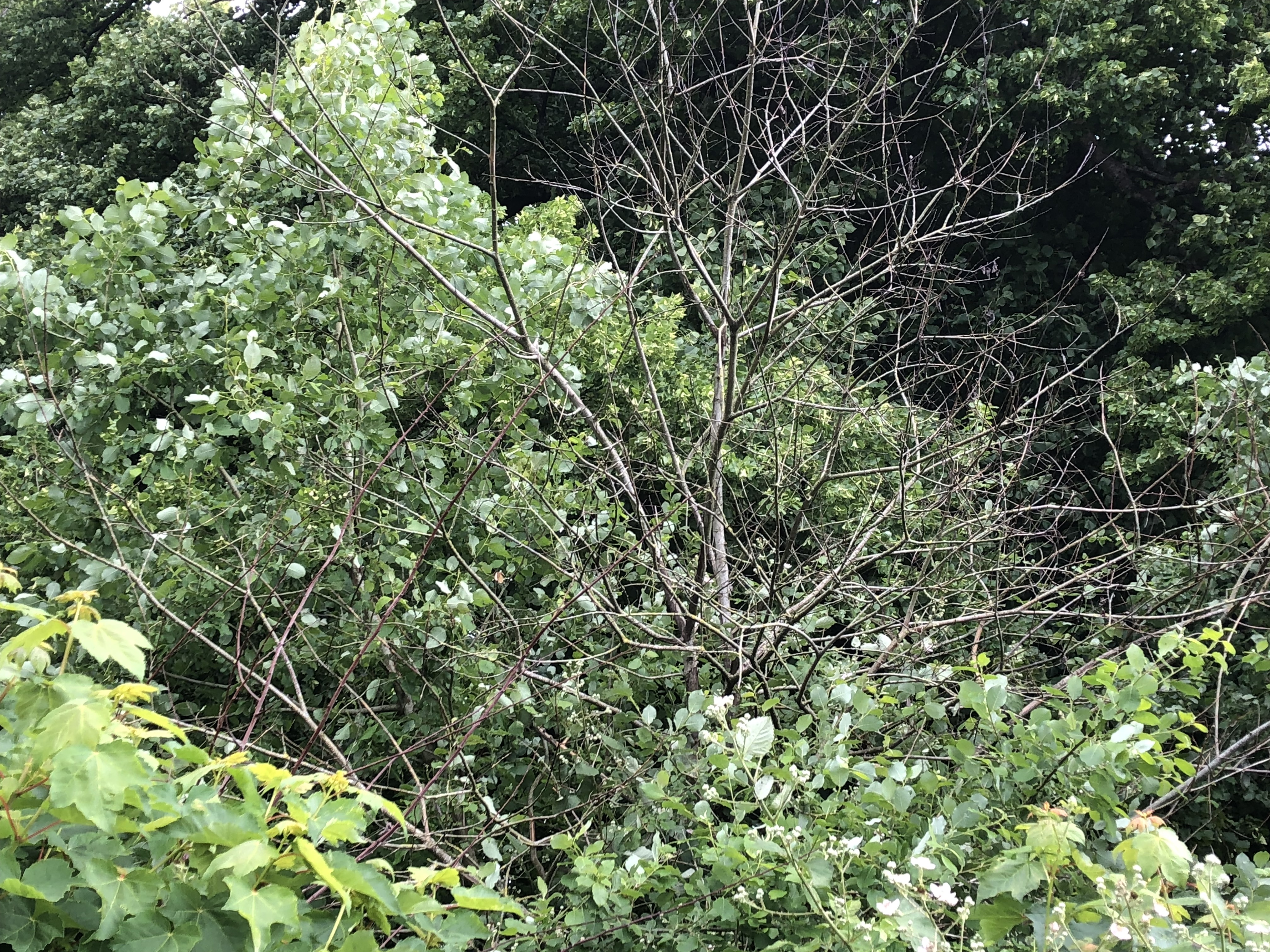
Unfortunately the PPA site hasn’t escaped such ravages as silver leaf and ash dieback. Where plot holders have asked for assistance, volunteers have removed members of the prunus family affected by the first, and the Council are watching some large ash trees, by plot ninety for the second. There’s also a clump of semi-mature willows, which appear to be pretty lifeless, and that’s perhaps down to the repeated but so far unsuccessful attempts by contractors to eradicate Japanese knotweed growing around them. (However, as it stands there at least isn’t any of it on the PPA side of the fence this year.) The trees have been reported to the Council as needing removal for safety reasons.

PPAA volunteers.