
A personal take by an allotment gardener
It’s been frustrating in recent years, for seasoned allotment gardeners to see so many overgrown plots being cleared for letting, only to have them soon neglected by their new tenants, and then left altogether, and for the whole business to start over again.
Having had a good look around the site over quite a while, it seemed that a lot of the ones who didn’t stick at it were younger tenants, and so some of us wondered whether this was maybe down to things like more pressing work and family demands, but then that didn’t really explain the fact of this turning up as a pattern over just the last few years.
After looking more closely at these plots though, one thing began to stand out. That is, most by far of the failed tenants had been trying to use the recently popular No Dig Method. Below are photos, of seven such struggling or deserted plots. In some of them the remains of the beds are too overgrown to be seen. (There are lots more around the site too.)

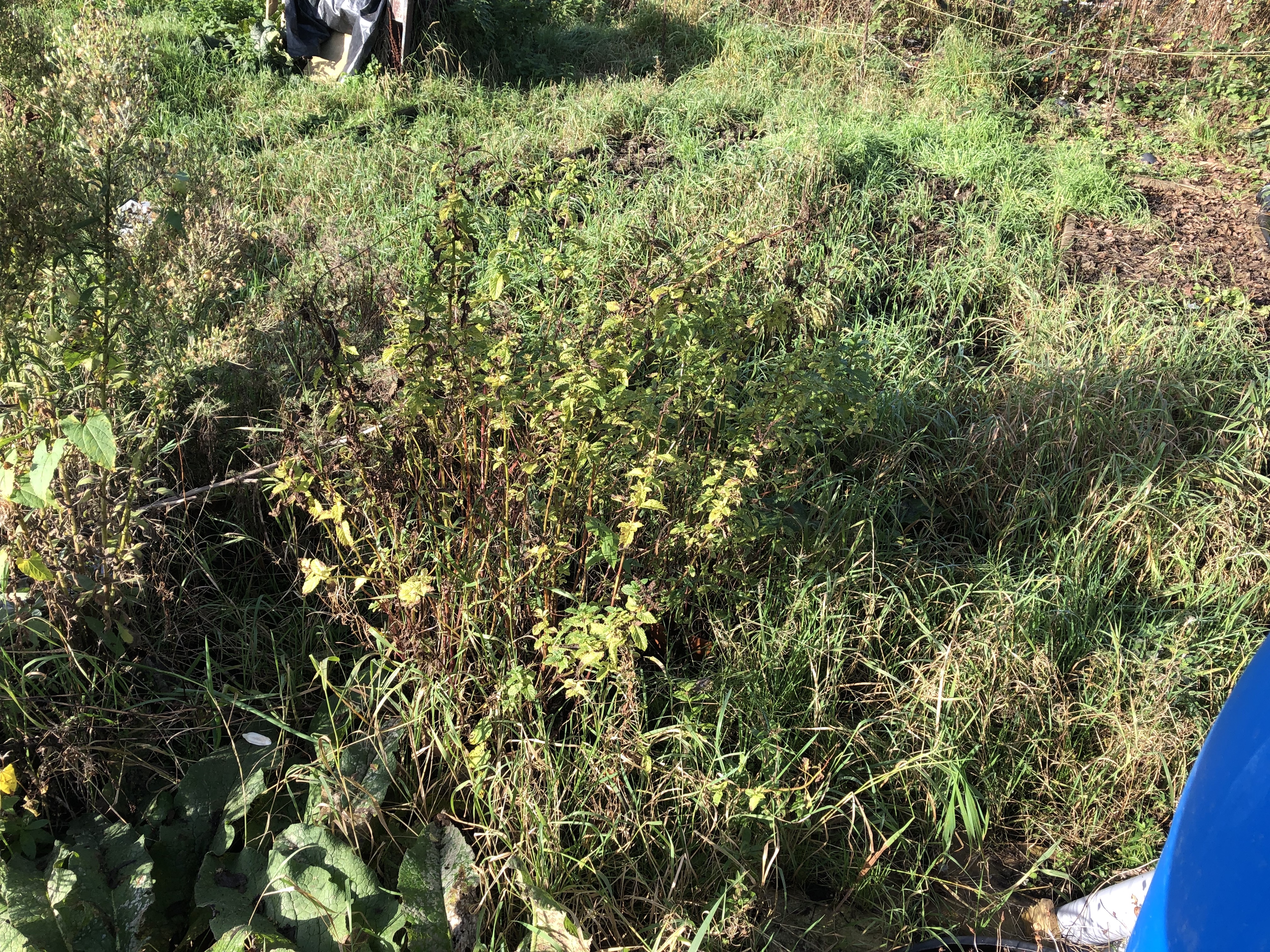

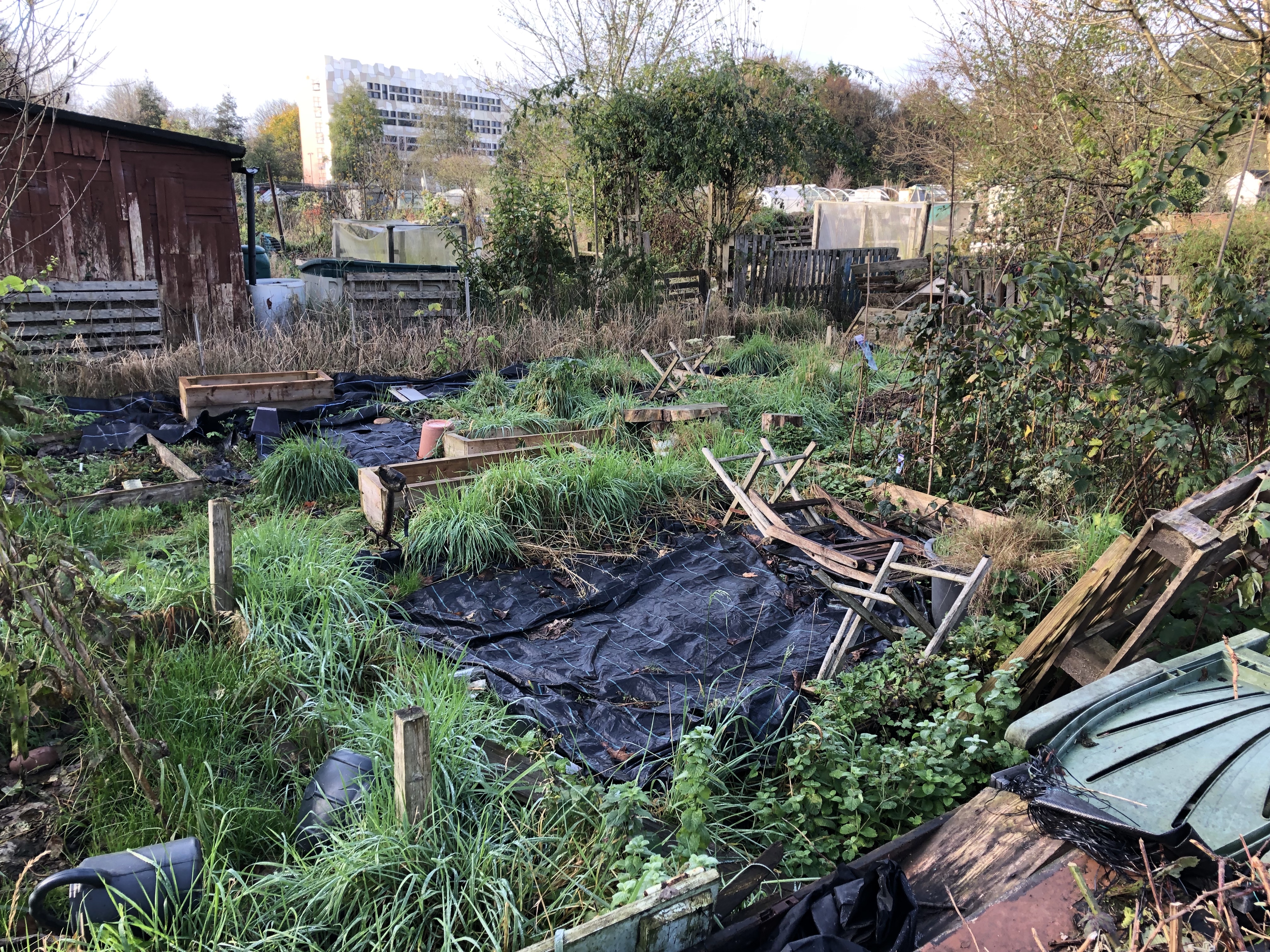


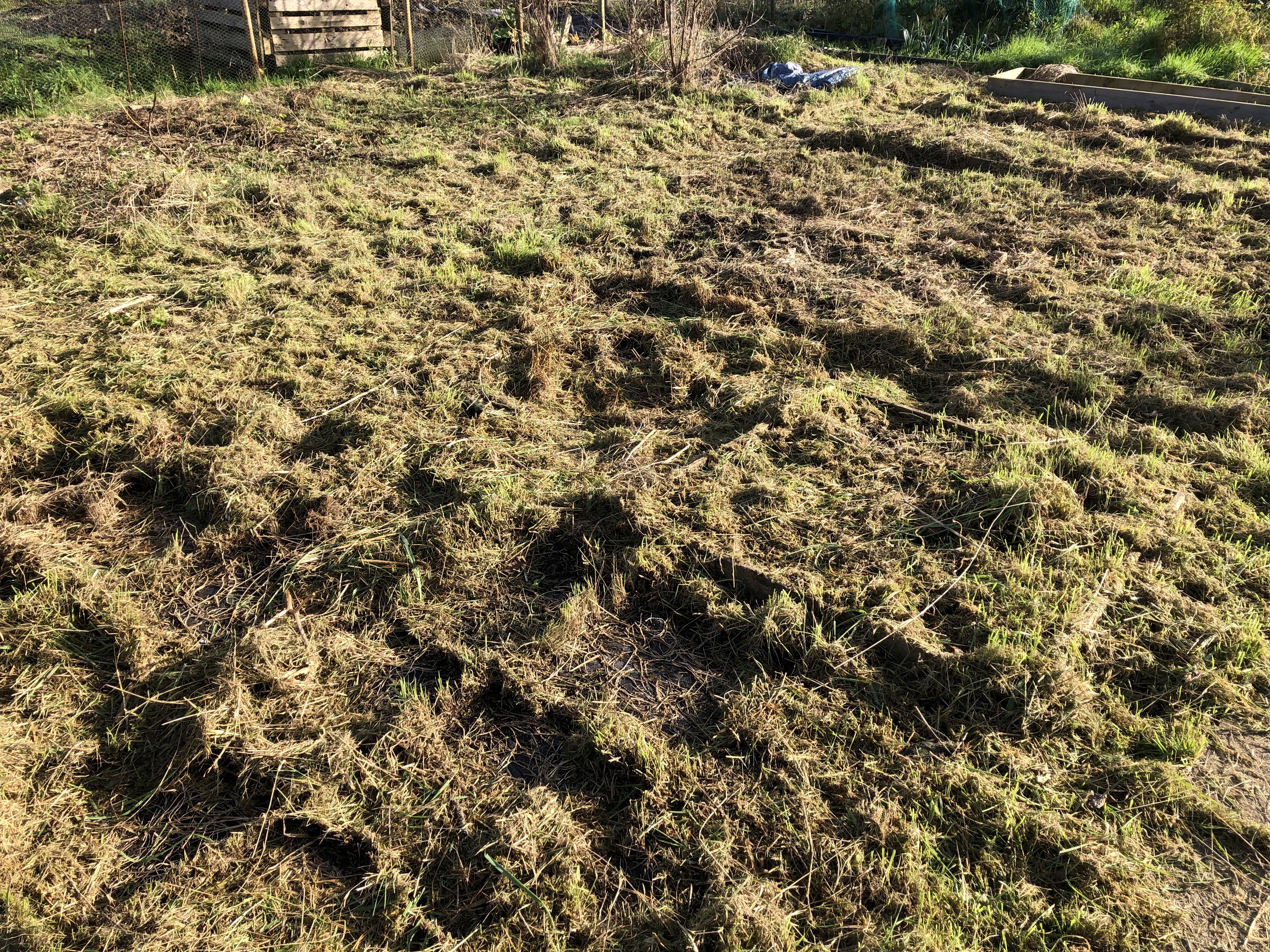
So what might have been the problems that put off these gardeners? Well, it could be that those with busy lives thought that they could have a productive allotment, but one which took up less time and energy than one gardened by traditional methods, and all the while make a contribution to safeguarding soil life and so on.
If that were so though, then would their beliefs stand up to cool-headed scrutiny? Or were they perhaps mistaken?
For a start, the raised beds seen involve the work and expense of making wooden frames, but with the damp climate here, untreated (or even “treated”) timber will be doing quite well to last more than a single season. Wood treated with a long life preservative that works – such as creosote – is a health hazard on the other hand, never mind not being organic. So there’s one problem.
Some of the weeds, like couch grass, bindweed, or horsetails, within or outside the beds, can’t be stopped by say, covering with corrugated cardboard, and they’ll force their way through whatever, so the task of weeding hasn’t gone away either. Deep rooted weeds, like hogweed of which there’s a great deal on the site – will also have to be dug out anyway if the gardener wants to avoid herbicides.
Often, the compost with which the beds are filled will have to be bought, and lugged from source to site. This is hard work, and expensive. A full plot would need tons of it, and at around eight pounds per bag this wouldn’t be cost-effective gardening at all.
If the beds are started on unturned soil, then there’ll likely be hardpan, that is, a hard layer of compacted soil beneath it, especially at the parts of the site where there’s clay. Plenty of crops need to put down deep roots, but they might struggle to do so into this, and so they won’t thrive.
Lots of plot holders have used wood chip to stifle weeds on the paths between the beds. This stuff is a real haven for slugs though, and those’ll come out to eat such crops as there might be. If they avoid slug pellets too, and don’t use other methods of dealing with them that actually work, then they’ll be lucky to take much home to eat.
The structure of good natural soil is usually one where near the surface there’s nitrogen-rich (but often mineral-poor) humus, populated by soil life – which feed on this – and as one goes deeper one meets nitrogen-poor (but often mineral-rich) clays and the like, but with little soil life. The whole point of ploughing or digging is to mix these together, to get a good balance of both nitrogen and minerals, as well as to break up the soil so that plant roots can get into it to whatever depth is needed (a long way for potatoes and other root crops.) It’s no great wonder, that humanity has been doing this for thousands of years, then.
The natural soil of PPA is made up of fertile flood plain deposits, and in plenty of places it’ll have been made better still, by generations of gardeners digging, manuring, and liming it. It’d be a happy thing, to see more gardeners reap the rich benefits of that.
On the other hand again, we seem to have some gardeners who do very well using the No Dig Method, but it looks like they’ve put a lot of thought into how they do what they do, and into what they grow. Sometimes they’ve bought the coated metal frames, which don’t rot (or use none at all). They’ve also got rid of strong weeds before building the beds, and they’ve broken up and turned the soil beneath them. They then fill and refill the beds with compost made from the ordinary soil of their plot and its plant waste. That said, this writer’s still left wondering, if all that care in what has to be done in fact needs far more rather than less time and effort on the part of the gardener than does traditional growing?

Have any of the Committee asked new tenants how they are getting on and why they are leaving? A little support and friendliness might help. A single tenant can find it lonely and some have said that no one talks to them
LikeLike
Hi Jane, you’re on the Committee.
Have you? 🙂
As for us, we volunteer workers generally do chat with whomever we meet, yes. The trouble is, those who neglect their plots…aren’t there.
But you’re right. A little support and friendliness would be a good thing all round 😉
LikeLike
The allotment site can be isolating since plotholders visit at different times and there isn’t a time or venue that encourages socialising.
As a committee member, I don’t know the names or plot numbers of tenants. Should these be shared? Do plotholders want this?
LikeLike
Hi Jane,
GDPR means that people’s personal details shouldn’t be shared unnecessarily, but whether that would mean that Site Representatives shouldn’t pass them on in bulk to other Committee members is something at present unclear to us.
LikeLike
looks like your offering to be the site emotional support Human jane
LikeLiked by 1 person
Sorry Jane, should have said earlier.
In the great majority of these cases we don’t need to ask, because we know why they left. It was because their tenancies were ended by the Council for non-cultivation.
LikeLike
I was referring to new tenancies, not those long standing enough to have grown over. A little interest in the first 6 months might be helpful to some
I have read the second longer explanation.
LikeLike
Untended plots become overgrown in weeks, Jane.
Then, by the time a tenant has gone through appeals against termination etc. it can be over two whole seasons. These are indeed often new tenants.
This is why we’ve now brought in the six-week trial period, during which Sue maintains contact to see how new tenants are doing.
One thing that the article author didn’t mention is the increased resolve by the Council to save money on plot clearances by enforcing the terms of tenancy more rigorously. That means that on giving up a plot or having tenancy ended, the tenant must dismantle structures such as beds and remove all the resulting scrap from site.
LikeLike
With reference to the allotment gardener and their thought’s on the No Dig method unfortunately they need to be to do some research first before they post about the method a good starting point would be look up Charles Dowding the committee can be put on their free mailing list which takes you through the process in real time another option is go to his you tube channel amongst all the books he has written there is a little gem about all the myths about surrounding gardening its a very good read
LikeLike
Hi Martin,
The author – as we understand it – doesn’t make any assertions about the method. They were, rather, commenting on what they’d actually seen around the site, and wondering if some of the tenants had been mistaken as to what needed to be done to make a success of it.
Thanks for the reference.
LikeLike
Perhaps not, but they do assert that “it seemed that a lot of the ones who didn’t stick at it were younger tenants”.
By contrast, it seems that most of the tenants that have point blank ignored me when I’ve tried to offer them a “hello” or “good morning” are ‘older’. Is there room on the blog for a post about that?
LikeLike
If you like, Mark, you can start a thread on “Conversation”, but do read the site’s policy on About This Website.
LikeLike
I have noticed that newer plot holders don’t realise how much work is involved when they take on a plot, and give up because of this, as they have time constraints due to work and children. With regards to support and friendliness, maybe you can take on that role as a committee member Jane, as others are spending their time doing the maintenance jobs around the site, which is ongoing all year round.
LikeLiked by 1 person
If you haven’t had gardening knowledge handed down by family, and search the internet, then you’d think that “no dig” was the only way to garden. Traditional gardeners are far less likely to put stuff out there than are people who want to push a method perhaps more because of its claimed eco credentials than its being easy or any good at producing much food.
LikeLiked by 1 person
I don’t think this is the place to get into the relative merits of gardening technique and indeed, I see what others do with their own plots as none of my business.
I would counter that whilst our plot is pictured (thanks for that) and cited as “struggling or deserted” we managed to produce onions, potatoes, garlic and beans in our first year of tenancy, as well as planting blackberries, rhubarb and lavender that should come good in future years.
That doesn’t seem too bad for our first year and far from “deserted” (it is mid-November, after all). I’m not sure allotments are designed solely for the pursuit relentless productivity, but perhaps that’s a misunderstanding on my part.
I’m also not sure what this post is attempting to achieve, the tone is, really, quite unkind and if you want to encourage membership and even support people, may I suggest that anonymous blog posts, singling out plots that you don’t like by appearance, isn’t necessarily the best way to do it?
The point on ‘younger’ people is quite….odd? I could note that when I’ve offered a “hello” or “good morning” I’ve been point-blank ignored by several people that appear on the ‘older’ side, but that probably wouldn’t be helping anything either and I wouldn’t consider age to be the relevant factor.
I should add that some people, particularly our plot neighbours, have been super friendly, supportive and helpful.
LikeLike
Hi Mark,
The point of the post – as we see it – is to try to offer an explanation as to why, lately, younger new tenants have an apparently higher likelihood of giving up soon after taking on a plot, since in the author’s experience this is a fairly recent occurrence. It’s a fact that during lockdown, the application interest for plots increased by a factor of seven, so perhaps people who weren’t that committed are working their way through the system?
Far from being unkind it seems rather to express concern, that applicants who could otherwise enjoy their plots have perhaps been misled – by incomplete advice – into an approach that doesn’t work for them, and leads to disappointment. There’s no implication that “young tenants are bad because they’re more likely to abandon their plots” either.
If you privately email PPAA using the contact form and tell us the slide number then we can remove the image of your plot.
Admin
LikeLike
Some plot holders have posted to express difficulties, and uncertainty as to how best to manage their plot.
Rather than to publicise those, a PPAA Committee member will contact them privately to offer advice, and if appropriate, to arrange a meeting on site.
We also thank any plot holder for offering their contact particulars for support to other tenants, but it’s very unwise for these to be published on a public website such as this, and so this isn’t done.
LikeLike
I’ve just read through the comments relating to the above article entitled ‘A mystery explained perhaps?’ and I felt that as the Committee member who deals with plot lettings and plot holder enquiries, I probably have an informed view re many aspects of PPA ‘life’.
I commented at our last Committee meeting that I’d noticed an interesting change in the demographic of people on our waiting list, and obviously now on the site. Going back a few years plot holders were, in the majority, retired, and often time rich. Now we’ve swung to the majority being under 45, working, managing family commitments, and often time poor.
In response to this change I have, over the last few years, offered smaller plots, with the option to apply for a second plot in the future. Most new plot holders find the smaller plots ‘enough.’ Some of the other sites in Cardiff – in response to changes in the demographics – are now trialing a ‘one bed’ system, maybe this could be something for the PPAA to consider?
We also now operate a six week ‘cool down/probation/love it/hate it’ period to new plot holders, between getting their plot and the tenancy being finalised. It’s been a helpful addition I believe for everyone.
When I let a plot, I often let the adjoining plot tenants know that they have new neighbours. Maybe we should start stating the plot numbers (obviously not names) of newly-let plots so that more people know to look out for a new face who might welcome a friendly ‘hello, I’m ….please feel free to borrow my wheelbarrow’ type of comments. However I’m aware also, that some people wish to be left alone when they’re on their plots, so it can be a bit of a minefield to navigate.
Mark commented that ‘I see what others do with their own plots as none of my business’. If he implied that it shouldn’t be anyone else’s either then my response is, as long as you are using your plot as prescribed in your tenancy. (If anyone’s unsure then they can find a copy of the Council-stipulated rules on this website, or can simply email the PPAA and ask their question.)
This has been a lengthy reply, but I hope that I’ve been able to answer some questions. Maybe it’s just raised more, but perhaps also ideas and maybe inspired some to offer support too.
LikeLike
I appreciate the concerns raised in the article about the challenges faced by allotment gardeners, particularly those using the No Dig method. However, I feel it’s important to address some of the points raised, especially from the perspective of younger gardeners who are actively engaging with sustainable practices.
While I agree that gardening requires hard work and commitment, I believe the article overlooks the broader context in which younger allotment holders are gardening today. Many of us are drawn to the No Dig method not only because it’s perceived as less physically demanding (though it’s far from effortless), but because it aligns with growing scientific understanding about soil health, biodiversity, and long-term sustainability. In addition, many of us are navigating increasingly stressful and demanding lives. Having access to an allotment (without judgement..) as a safe space to disconnect and reconnect with nature can be incredibly valuable.
It’s crucial that all gardeners (regardless of age or financial status) feel welcome and supported. However, I believe the solution is not to dismiss newer, science-backed methods, but to embrace a more inclusive and open-minded approach within the allotment community. Younger gardeners, like those of us using the No Dig method, often bring a wealth of enthusiasm, and a strong commitment to environmental conservation. We should be encouraged, not discouraged, in our efforts to engage in gardening practices that prioritise sustainability and long-term ecological health. As a new plot-holder I have loved getting to know and absorbing wisdom (dig or no dig!) from my plot neighbours but feel this article does lack a bit of tact and compassion.
LikeLike
Hi Appletree,
Thanks for your thoughtful comment.
However, the article simply addresses some facts, and speculates as to what the explanation for them might be.
PPAA’s priority is to see as many plots happily occupied as possible.
However, far too many are becoming neglected under exactly the circumstances described, and so any ideas which might encourage gardeners to consider a range of approaches rather than becoming preoccupied with just one that obviously doesn’t suit are very welcome.
We’re sorry if some of those straightforwardly-reported facts make anyone feel uncomfortable, however.
Admin
LikeLike